Software development · IT services
Software engineered to keep working.
JOLI HOMES LTD builds custom applications, web platforms, integrations and cloud infrastructure — written to be understood, tested and maintained long after launch.

01 — Who we are
An IT company that treats code as a long-term asset, not a one-off deliverable.
We work with organisations that need software built properly: clear requirements, sensible architecture, automated tests and documentation that a future team can pick up. Our role ranges from building a product from scratch to strengthening and extending systems that already exist.
02 — Core expertise
- 01Custom softwareBusiness applications shaped around your processes.
- 02Web applicationsBrowser-based products, portals and dashboards.
- 03APIs & integrationsConnecting services, data sources and third-party platforms.
- 04Cloud infrastructureHosting, deployment pipelines and environment management.
- 05Quality assuranceAutomated and manual testing across the delivery cycle.

03 — Custom software development
Built for the way you actually work.
Off-the-shelf tools often force teams into workarounds. We design software around real workflows — internal tools, process automation, back-office systems and domain-specific applications — starting from discovery and iterating in small, reviewable increments.
- Requirements & discovery
- Domain modelling
- Iterative delivery
- Handover documentation
04 — Web application engineering
Fast, accessible, maintainable.
Frontend
Responsive interfaces with attention to accessibility and performance on real devices.
Backend
Well-structured server logic, data models and authentication flows.
Data
Relational and document databases chosen for the workload, with migrations under version control.
Delivery
Repeatable builds and staged environments so releases are routine, not risky.

05 — Cloud infrastructure & integration
Infrastructure you can reason about.
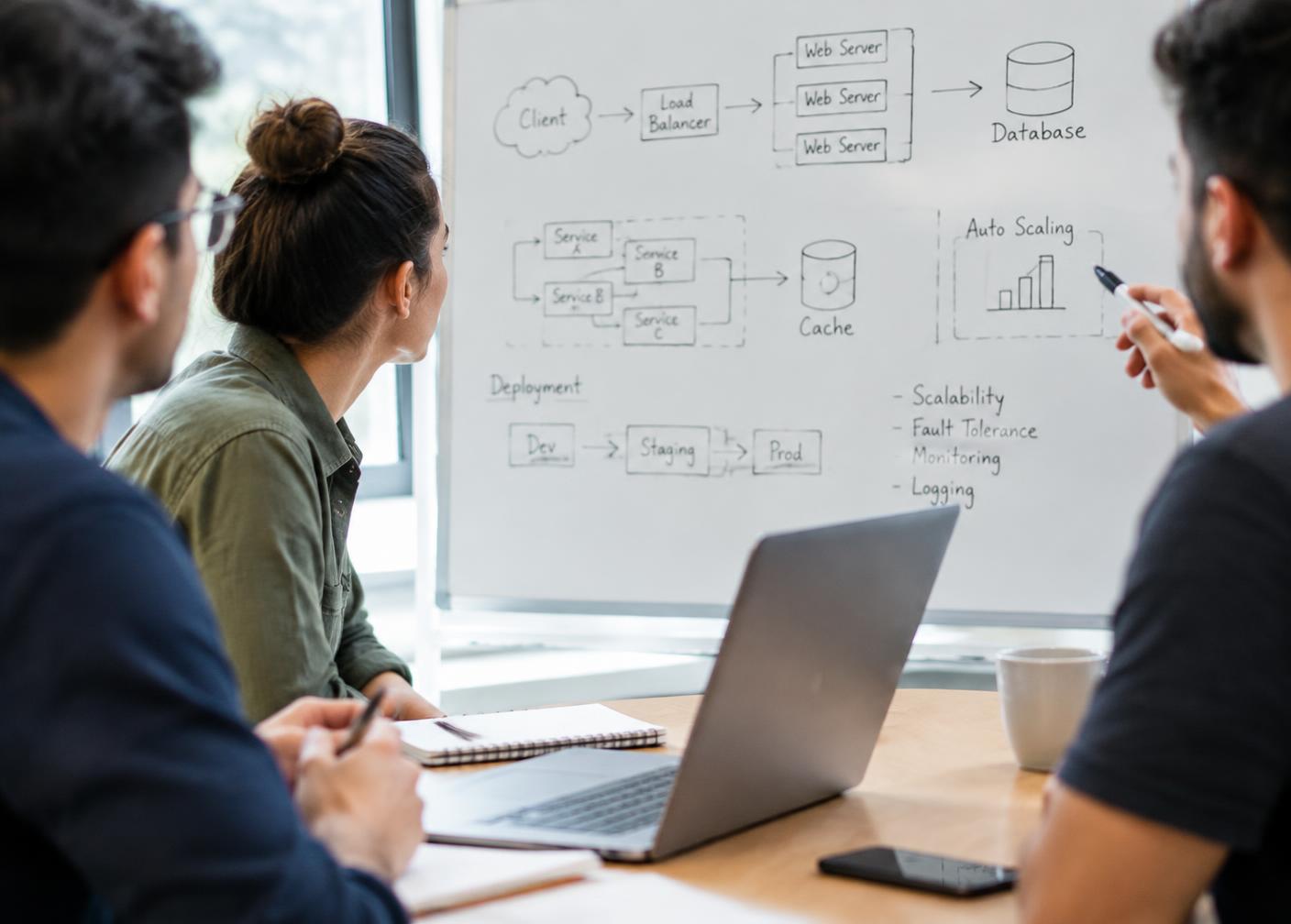
We set up and maintain cloud environments with infrastructure defined as code, automated deployment pipelines, logging and monitoring. Where systems need to talk to each other, we build integrations with clear contracts, retries and error handling.
06 — Quality & reliability
Testing is part of building, not a phase after it.
Unit & integration tests
Core logic and boundaries between components are covered by automated checks that run on every change.
End-to-end scenarios
Critical user journeys are exercised in a browser to catch regressions before release.
Code review
Every change is read by another engineer before it is merged.
Observability
Errors and performance are measured in production so problems are found early.
07 — Development workflow
From question to production, in visible steps.
- 1
Discover
Goals, users, constraints and existing systems.
- 2
Plan
Scope, architecture and a prioritised backlog.
- 3
Build
Short iterations with regular demos.
- 4
Verify
Automated tests, review and acceptance.
- 5
Operate
Release, monitor, maintain and improve.
08 — Engineering principles
Clarity over cleverness
Code is read far more than it is written. We optimise for the next person to open the file.
Small, reversible changes
Frequent, incremental releases reduce risk and make problems easy to trace.
Explicit trade-offs
Decisions about cost, speed and complexity are discussed openly and written down.
Ownership of outcomes
We care whether the software is useful, not only whether a ticket is closed.
Proven tools first
We choose mature, well-supported technology unless there is a clear reason not to.
Documentation as a deliverable
Architecture notes, runbooks and setup guides ship with the code.
09 — Where we can help
Business scenarios our services support.
- Replacing spreadsheets with internal tools
- Customer portals and self-service
- E-commerce back-office automation
- Booking and scheduling systems
- Reporting dashboards
- Mobile app backends and APIs
- Legacy system modernisation
- Payment and CRM integrations
- Data migration between platforms
- Cloud migration of existing apps
- Logistics and operations tracking
- Education and content platforms
10 — Security-conscious development
Security considered from the first commit.
- →Least-privilege access for services, databases and team members.
- →Secrets kept out of source code and rotated when needed.
- →Input validation and parameterised queries by default.
- →Dependencies tracked and updated against known vulnerabilities.
- →Personal data minimised, encrypted in transit and access-logged.

11 — Questions
Frequently asked questions
- Do you work on existing codebases?
- Yes. We can review, stabilise and extend software that is already in use, starting with an assessment of its current state.
- How is a project scoped?
- We begin with a discovery conversation, then agree on goals, priorities and a first deliverable before larger commitments.
- Who owns the code?
- Ownership terms are agreed in the contract for each engagement and documented before work begins.
- Can you support software after launch?
- Yes. Maintenance and technical support can continue after release, covering fixes, updates and monitoring.
- Which technologies do you use?
- We select mainstream, well-supported languages, frameworks and cloud platforms suited to the project and the team that will maintain it.